

WHAT IS THE STOIC PROTOCOL?
A Framework Designed for Practice, Not Consumption
The Stoic Protocol exists because most people do not struggle with understanding ideas.
They struggle with applying them consistently.
Stoic philosophy is widely available. Quotes, summaries, and interpretations are everywhere. What is rare is a practical framework that turns philosophy into daily behavior rather than passive reflection.
The Stoic Protocol was created to address that gap.
It is not a reinterpretation of Stoicism.
It is a system designed to make Stoic principles actionable through repetition, structure, and accountability.
The Problem This Protocol Was Designed to Solve

Modern self-development encourages constant intake. More information. More ideas. More inspiration.
What it rarely encourages is follow-through.
Many people read about discipline without practicing it. They collect insights without changing behavior. Philosophy becomes something admired rather than lived.
Stoicism, in particular, is often reduced to quotes and concepts. Wisdom is discussed, but not trained. Temperance is admired, but not practiced. Courage is praised, but rarely tested. Justice is referenced, but not examined internally.
The Stoic Protocol exists to shift Stoicism from something you read into something you do.
Why Stoicism Needed a Practical Framework
Stoicism was never meant to be theoretical.
Historically, it was a philosophy of daily discipline. It emphasized self-examination, restraint, responsibility, and alignment between thought and action. These practices were meant to be repeated, not consumed once and forgotten.
In modern life, that structure is missing.
Without a framework, even strong ideas lose their force. Without repetition, principles remain abstract. Without reflection, behavior remains unchanged.
The Stoic Protocol restores structure to Stoic practice by giving philosophy a daily form.
What Makes the Stoic Protocol Different
The Stoic Protocol does not attempt to motivate, inspire, or energize.
It is intentionally limited, finite, and structured.
It is not open-ended.
It does not encourage constant novelty.
It does not reward intensity over consistency.
Each day follows the same disciplined framework. The repetition is deliberate. Discipline is not built through variation. It is built through steady practice.
This approach rejects the idea that growth requires constant stimulation. Instead, it reinforces the idea that growth requires consistency and restraint.
Discipline as a Designed System
Discipline does not emerge spontaneously. It must be designed.
The Stoic Protocol treats discipline as something that can be trained through structure. Each component of the daily framework serves a specific function.
Principles direct attention.
Mental exercises build awareness.
Action challenges apply ideas to behavior.
Reflection reinforces accountability.
Together, these elements create a closed loop. Thought informs action. Action informs reflection. Reflection sharpens judgment. Judgment improves future action.
This loop is repeated daily, allowing discipline to compound rather than reset.
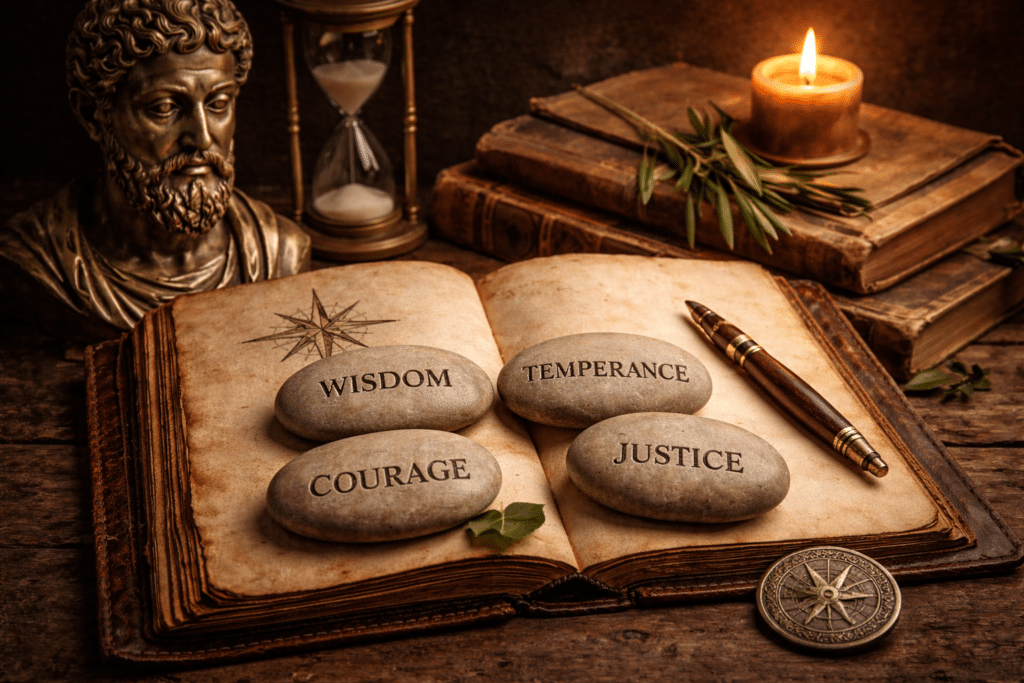
The Role of the Four Stoic Virtues
The Stoic Protocol is grounded in four virtues that guide human conduct.
Wisdom governs perception and judgment.
Temperance governs restraint and moderation.
Courage governs action under discomfort.
Justice governs responsibility and integrity.
These virtues are not treated as ideals to admire. They are treated as behaviors to practice.
The protocol integrates them into daily work so they become habits rather than abstractions.
The Role of the Four Stoic Virtues
The Stoic Protocol is grounded in four virtues that guide human conduct.
Wisdom governs perception and judgment.
Temperance governs restraint and moderation.
Courage governs action under discomfort.
Justice governs responsibility and integrity.
These virtues are not treated as ideals to admire. They are treated as behaviors to practice.
The protocol integrates them into daily work so they become habits rather than abstractions.
The Commitment Required
The Stoic Protocol requires engagement.
It requires writing.
It requires reflection.
It requires honest examination of behavior.
This is intentional.
Discipline cannot be developed passively. Responsibility cannot be outsourced. Growth requires participation.
This protocol is not designed for casual browsing or selective completion. Its effectiveness depends on consistency and follow-through.
What Completion Represents
Completion matters.
Finishing the Stoic Protocol is not about achievement or recognition. It represents follow-through, responsibility, and respect for the work.
The final phase of the protocol emphasizes continuation rather than closure. The goal is not to complete thirty days and move on. The goal is to integrate disciplined practice into daily life beyond the workbook.
Completion marks the transition from guided structure to self-directed responsibility.
Practice Over Consumption
The Stoic Protocol does not promise transformation.
It provides a system.
What results from that system depends on engagement, honesty, and consistency.
This is not a challenge.
It is not a program.
It is not motivation.
It is a deliberate practice built on principles that endure.