










Discipline is one of the most misunderstood traits in modern self improvement. Many people believe they are disciplined because they work hard at times, feel motivated occasionally, or intend to improve eventually. In reality, discipline is defined by consistency of behavior, not intention or effort in isolation.
This disconnect is why so many people overestimate their discipline and struggle to make lasting progress.
Motivation fluctuates. Discipline does not.
If discipline depended on how someone felt, it would collapse the moment conditions became inconvenient. True discipline is revealed when effort continues despite boredom, resistance, emotional stress, or lack of reward.
From a Stoic perspective, discipline is a standard of conduct, not an emotional state. What matters is not how motivated you feel, but what you consistently do regardless of internal conditions.
Stoic philosophy approaches discipline through self command and restraint. A Stoic does not ask how they feel before acting. They ask what must be done.
This distinction separates disciplined behavior from emotional behavior. Discipline is governed by principle and structure, not impulse. Without structure, even strong motivation eventually fails.
This is why Stoicism emphasizes clarity, restraint, and personal responsibility over inspiration.
Most people evaluate their discipline emotionally rather than objectively. They remember moments of effort while overlooking patterns of avoidance. They measure progress by how busy they feel instead of what they complete consistently.
Common errors include:
Confusing intention with execution
Overvaluing short bursts of effort
Explaining inconsistency instead of correcting it
Ignoring repeated avoidance
Without a framework, self assessment becomes self justification.
You cannot correct what you refuse to measure.
A Stoic discipline audit removes narrative and replaces it with clarity. It reveals where discipline is strong, where it is inconsistent, and where it is compromised. This is not about judgment. It is about accuracy.
Stoic discipline requires honest measurement before meaningful correction can occur.
A Stoic discipline audit evaluates discipline across five critical domains:
Emotional regulation and impulse restraint under pressure.
Execution, prioritization, and follow through.
Comfort seeking, indulgence, and avoidance.
Consistency of behavior regardless of observation.
Tolerance for discomfort, resistance, and difficulty.
Many people rush into routines, programs, and systems without understanding where their discipline is failing. This leads to wasted effort and frustration.
A Stoic discipline audit provides clarity first. Training is most effective when it is directed toward the weakest domain. Correction compounds when focus is precise.
A Stoic discipline audit does not motivate or console. It measures behavior. It identifies leaks in discipline without emotion or justification.
Low scores do not imply failure. They identify priority.
This level of clarity allows disciplined action to replace guesswork.
If you want an honest assessment of your discipline without emotion or explanation, the Stoic discipline audit provides that clarity.
It is designed to be used:
Before beginning structured training
After lapses in discipline
When progress feels stalled
Periodically to recalibrate standards
You can find it here:
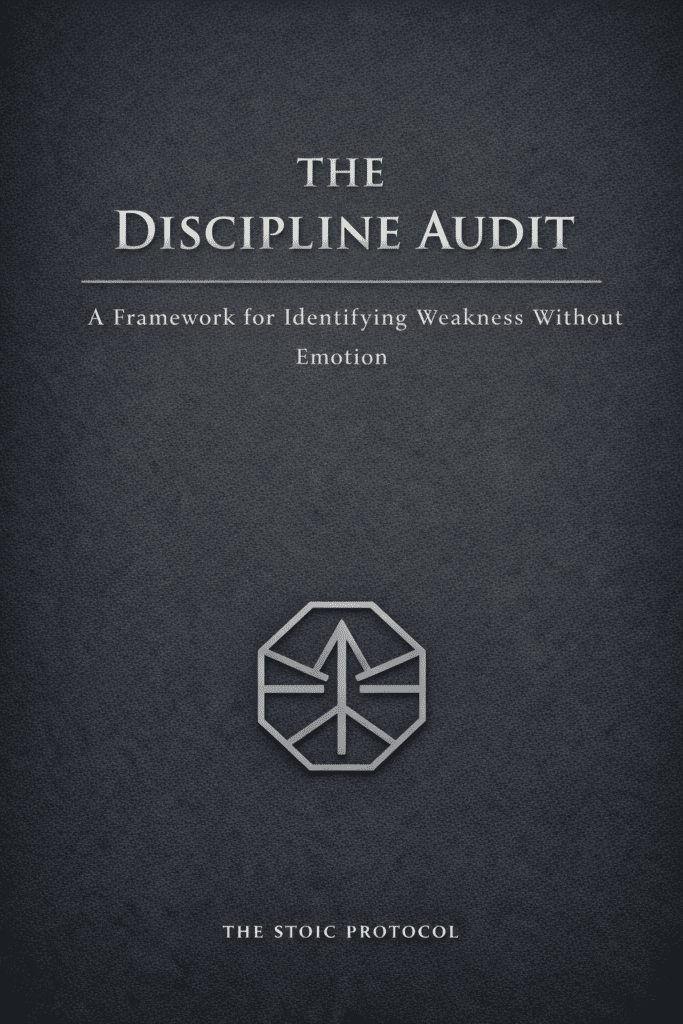
The Discipline Audit A Stoic Self Discipline Assessment Tool

FREE SHIPPING is now available.
Start with Phase One or order all three for the complete Stoic Protocol.